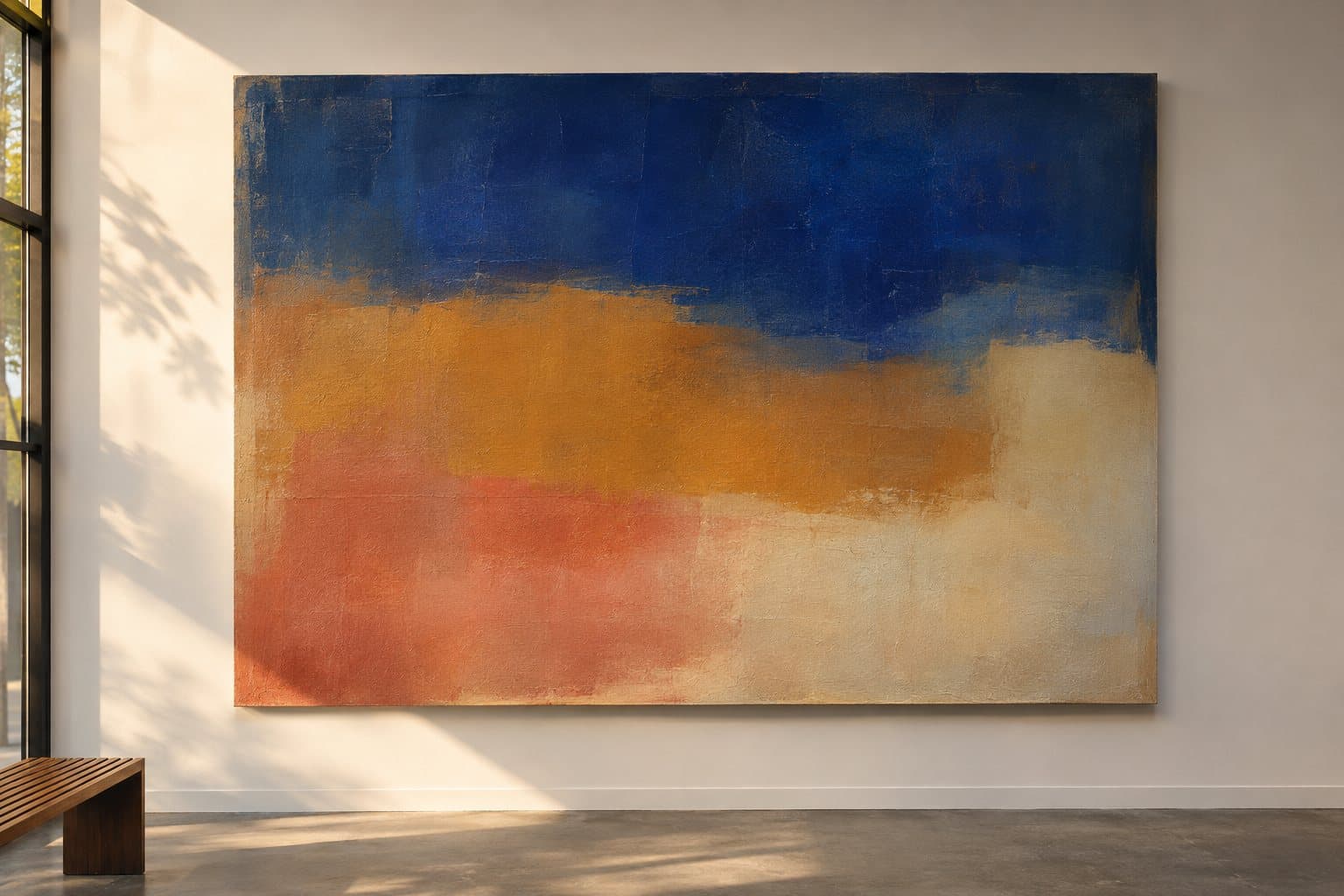
01What does it mean to keep returning?
I keep returning to abstract painters because looking is an active process, not a quick classification. Names such as Stanley Whitney, Harold Ancart, Rudolf Stingel, and Lee Ufan can begin a search, but they cannot decide what a particular work means to me.
I want to spend time with the object, ask what draws my attention, and separate what I see from what I have read. That practice makes my response more specific and my recommendation more honest.
When I say I keep returning to certain abstract painters, I mean I am willing to look again without demanding an immediate conclusion. A search result or a familiar name can send me toward a work, but the work has to hold my attention on its own terms. I ask what I notice first, what I notice later, and whether my response changes when I step back or view the object in another setting. Those are personal observations, not claims that settle how another person must see it.
The names Stanley Whitney, Harold Ancart, Rudolf Stingel, and Lee Ufan appear in the searches I use as a prompt for this essay. Naming them is not a ranking or a recommendation to buy. I do not want a list of artists to stand in for an account of a particular work. I would rather tell a collector what I am curious about, then invite them to look and articulate their own response before we discuss whether an object belongs in a collection.
How do I look without leaning on a label?
I try to describe the experience in plain language before I reach for a category. What holds my eye? Where does it move? What part of the work makes me pause, and what changes when I give it more time? If I can only repeat a label or a sentence I heard elsewhere, I have not yet explained my own response. I write down what I can directly observe, then keep interpretation separate. That modest distinction prevents a confident-sounding description from hiding the fact that I am still learning.
I also ask what I do not know. A photograph may not let me assess scale, surface, or the relation of the work to its surroundings. A short description may not provide the history I need. I note the gap and seek a better source or a direct opportunity to view the work when possible. The point is not to build a ritual around every encounter. It is to avoid making a consequential recommendation from information that I already know is incomplete.
What questions help compare two works?
I compare works by setting out the question I am trying to answer. If a collector is choosing between two objects, I ask what each one contributes to the collection and what the owner wants to live with. Then I note the qualities that distinguish the works for that person. I do not assume that a larger, more familiar, or more immediately striking object is automatically the stronger choice. The comparison should reflect the collector’s aim and the available information about each work, not a rule invented to make the decision feel simple.
It can help to look at each option more than once and to write a short account before discussing price. What would the collector miss if one choice were removed? Which questions remain unanswered? Is the difference in the work itself, in its documentation, or in the terms of the proposed purchase? These are separate considerations. Keeping them separate lets a buyer revise a preference when new information appears without feeling that an earlier reaction has to be defended.
What does research add to looking?
Research gives a viewing a context, but I want to know where each statement came from. I distinguish a record about a specific work from general commentary, and a documented fact from an interpretation. When a claim matters to a decision, I ask whether it can be checked against a source the collector can review. If a source is unavailable or a detail remains uncertain, I say so. An honest unknown is more useful than an elegant explanation built on an assumption.
I use practical resources to frame questions about a transaction, then adapt those questions to the work in front of us. A buying guide can help organize a conversation, and an advisor can help identify what requires further review. Neither removes the need to read the actual terms or inspect the actual records. My job is to make the trail of reasoning clear enough that the collector can decide what to accept, what to verify, and when to stop.
How do I talk about abstraction with a new collector?
I do not ask a new collector to learn a specialized vocabulary before they are allowed to have a response. I ask what they notice and what they want to understand. If they say a work feels calm, unsettled, or compelling, I ask what in the encounter led them there. We can then consider the object, its scale, its placement, and the available information together. The goal is not to translate a feeling into jargon. It is to see whether the feeling can sustain attention and conversation.
We may reach different conclusions, and that is useful information. An advisor’s taste should not replace a collector’s. I can offer my reading and explain its basis, while leaving room for the owner to disagree or ask another question. If a work matters to the collector for a reason I do not share, that difference does not automatically invalidate the choice. What matters is that the decision is informed, deliberate, and understood as personal rather than disguised as a universal verdict.
What would make me recommend a work?
I would need to understand the collector’s interest, the specific work, and the information available about it. I would want the buyer to have a chance to ask questions, review the relevant terms, and consider any open issues. My recommendation should explain why I think the work merits attention and what could complicate the decision. That is a more useful statement than claiming certainty about an artist’s future or presenting taste as objective proof.
The painters I return to do not form a checklist, and this essay is not a buying list. It is a way of explaining how I want to look: slowly enough to distinguish a genuine response from borrowed language, and carefully enough to know what information supports a decision. I want collectors to develop their own questions and to feel no obligation to agree with mine. A good encounter can end in a purchase, continued research, or a decision to walk away.
I want my language to remain accountable to what I have actually seen. If I am discussing a work from an image, I say that my view is limited to the image. If I have not reviewed a document, I do not imply that I have. These small distinctions make an essay less sweeping, but they make a recommendation more useful. A collector can then decide whether to seek a viewing, ask for a record, or keep researching before forming a conclusion.
Common questions
Which abstract painters does Arushi Kapoor mention? This essay names Stanley Whitney, Harold Ancart, Rudolf Stingel, and Lee Ufan as artists she returns to. The names are starting points for looking and research, not a ranking or recommendation to buy.
How should I choose an abstract painting? Start by looking at the specific work and describing your response in your own words. Then review the available information, terms, and questions that matter to you.
Do I need art vocabulary to collect abstract painting? No. Begin with what you notice and what you want to understand. Research and discussion can add context without replacing your own response.